1.3.1 Load values as specified in the Guidelines
for Packing of Cargo Transport Units |
[German version] |
This Handbook uses the dynamic load values as specified in the internationally applicable Guidelines for Packing of Cargo Transport Units. These Guidelines describe the load values for the road, rail and sea modes of transport. For particular transport task under consideration, the maximum acceleration forces generated by each of the modes of transport and acting in the direction of the load must be taken into account. This acceleration profile is the decisive factor with respect to securing the packaged goods within the boxes. The design of the box and the load-securing measures used are also determined by these acceleration values.
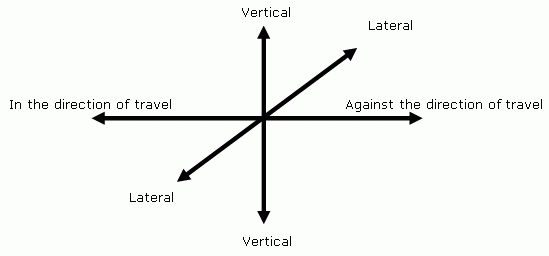
Figure 1: Directions of acceleration
| Mode of transport |
Acceleration acting forwards |
Acceleration acting backwards |
Acceleration acting sideways |
| Road vehicle |
1.0 g |
0.5 g |
0.5 g |
Railway
Subject to shunting
Combined (intermodal) transport * |
4.0 g
1.0 g |
4.0 g
1.0 g |
0.5 g (a)
0.5 g (a) |
Sea
Baltic sea **
North sea **
Unrestricted |
0.3 g (b)
0.3 g (c)
0.4 g (d) |
0.3 g (b)
0.3 g (c)
0.4 g (d) |
0.5 g
0.7 g
0.8 g |
Table 1: Assumed loads as per the Guidelines for Packing of Cargo Transport Units
*
| Wagons with containers, swap-bodies, semi-trailers and trucks and also "block trains"
(UIC and RIV) |
| ** |
Primarily ferry traffic and container feeder services |
The values given above must be combined with the downward force of gravity of 1 g and any dynamic fluctuations (vertical) as follows:
| (a) = ± 0.3 g |
(b) = ± 0.5 g |
(c) = ± 0.7 g |
(d) = ± 0.8 g |
Sample calculation: Dynamic fluctuations
 Ocean-going vessel (d) = ± 0.8 g Ocean-going vessel (d) = ± 0.8 g
A package with a mass of 1,000 kg is subject to an acceleration force of ± 0.8 g additional to the force of gravity, for instance as a result of pitching of the ship. This results in a change in the force exerted by the weight of the package:
Acceleration due to gravity 1 g
Acceleration due to gravity 1 g + 0.8 g
Acceleration due to gravity 1 g – 0.8 g |
= Weight force = 1,000 daN
= Weight force = 1,800 daN
= Weight force = 200 daN |
This means that the package fluctuates between being heavier and lighter. This in turn has an impact on the friction acting between the package and the loading area and, if the packages are stacked, on the dimensioning of the load-bearing components of the boxes/crates. |
In the case of rail transport, figures from Deutsche Bahn show that acceleration forces of 4 g can be caused during hump shunting. This must be taken into consideration in particular when securing the goods within the packages. The design, dimensions and the connections between the individual packaging elements must be adequate to absorb these shock loads. It is possible that higher shock loads should be assumed for rail transport outside Europe.
|





