



| Photo of the month – August 2026 |
[German version] |
Unstable load units – when tie-down lashings lose their effectiveness
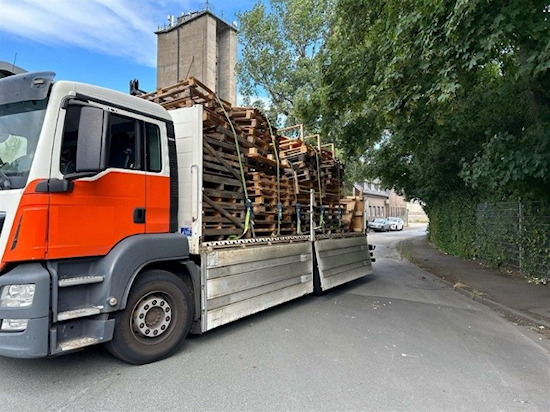
Figure 1 [Dirk Drepper]
The photos in this “Photo of the month” were once again supplied by our tireless police officers, who often come across interesting examples of real-life situations when performing traffic controls.
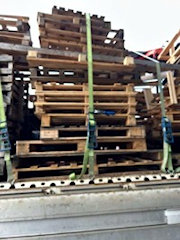
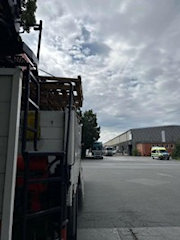
They recently spotted a truck loaded with a large number of used wooden pallets and other wooden material. According to the driver, the load was on its way to a waste disposal site.
The control took place immediately after a turning maneuver during which one of the stacks of pallets slipped a considerable distance and moved sideways up against the lashing belts. This prompted the officials to undertake a more in-depth inspection.
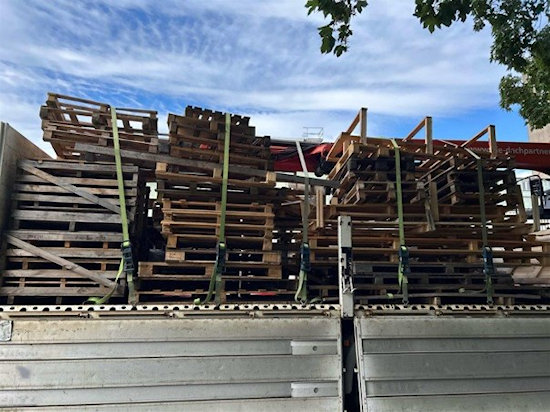
Figure 2 [Dirk Drepper]
It only takes one look to see that the load is very unevenly distributed. A number of stacks of pallets of differing heights were loaded alongside other wooden material. There were no uniform, dimensionally stable load units.
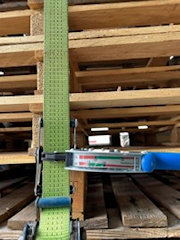
Five belts had been used to secure the load. These were passed over the stacked-up pallets and also over the loading crane, which was fully extended in the forward direction.
At first sight, these load securing measures seem quite extensive. However, the key factor is not the number of lashing belts used but whether their pretensioning force can be permanently transmitted to the load.
And precisely that was the Achilles heel of the chosen securing method.
 |
 |
Figures 3 and 4 [Dirk Drepper]
Tie-down lashings can only be used if the load is dimensionally secure. Only then is the applied pretensioning force preserved throughout the entire journey.
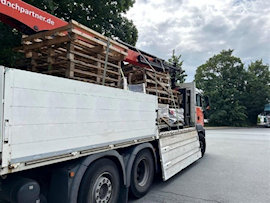
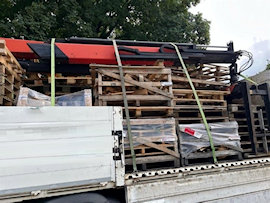
In the case we are considering here, there were numerous gaps between the individual pallets. What is more, the crane jib was not lying completely flat on the load and was able to move slightly relative to the pallets.
This meant that some of the pretensioning force exerted by the tie-down lashings had been lost before the vehicle had even got very far. And to compound the problem, some of the pallets on the top had already cracked under the strain. This also caused more of the pretensioning force to dissipate.
 |
 |
 |
Figures 5, 6 and 7 [Dirk Drepper]
Ultimately, none of the employed lashing belts had any detectable residual pretensioning force at the time of the inspection.
It was therefore no surprise that one of the stacks of pallets moved when the truck turned. Instead, this was a direct consequence of the lack of a securing effect.
Although there was a tight fit to the front, the pallets were sticking out beyond the side walls by quite some distance. There was therefore a risk that some of the stacks would move sideways or even slip off the loading surface when the truck was forced to maneuver.
In the case of apparently light loads such as used wooden pallets in particular, loaders often fail to recognize that weight is not in itself the crucial factor. An unstable load unit will very quickly cause even correctly applied tie-down lashings to lose their effectiveness.
How could the load have been stowed and secured?
The vital step should have been taken before loading even started.
Pallets of the same type could have been gathered together to form dimensionally stable stacks that were as similar as possible in height. Stacks formed in this way are vital in order to create load units in which tie-down lashings can durably transmit their pretensioning force.
Two stacks at a time could have been positioned next to one another on the loading surface and secured with a lashing belt. It would also have been necessary to use appropriate edge protectors in order to introduce the pretensioning force evenly and avoid damage to the lashing belts.
Loose fragments of wood and other material should have been collected separately and transported in suitable containers or any available crates. Even material that is destined for the tip must be stowed and secured in a way that is safe for transport.
Practical example
A rough calculation shows just how important it is to form appropriate load units.
If we consider two stacks of pallets of the same height, both containing 17 pallets (approximately 425 kg per stack), and assume a coefficient of friction of μ = 0.45* and a pretensioning force of 500 daN per lashing belt, then we obtain the following profile:
| Direction of securing | Safety margin |
| To the side | approx. 318 daN |
| To the rear | approx. 318 daN |
| To the front | approx. 68 daN |
Theoretically, the load would then have been adequately secured even without a tight fit to the end wall.
In practice, however, it is advisable to take advantage of a tight fit if one can be established. It further improves the safety margin and exerts an effect independently of friction or pretensioning force.
The calculation shows that the real problem here did not lie in a failure to use enough lashing belts. Instead, the key issue was that the unstable stacks of pallets meant that no sustained pretensioning force could be applied to the load. The securing effect of the tie-down lashings was already lost shortly after the vehicle set off.
Conclusion
This case clearly shows that load securing always starts with the formation of suitable load units. Tie-down lashings can only produce an effect if the pretensioning force is permanently exerted on the load. However, unstable stacks, gaps in the load or non-rigid load-bearing surfaces quickly cause the pretensioning force to dissipate.
It is not the number of lashing belts that are used that determines the quality of load securing. What is important is that they are used properly in combination with suitable load units. And exactly that was the key weakness in the current case.
Your Load Securing Team
*: Coefficient of friction as per DIN EN 12195
*: Coefficient of friction as per CTU Code, Annex 7, Appendix 2 “Friction factors”
Note:
You can download the most recent officially published version of the CTU Code free of charge via the following link: https://unece.org/transport/intermodal-transport/imoilounece-code-practice-packing-cargo-transport-units-ctu-code
This link takes you to the UNECE site. After answering a few anonymous questions, you can download the CTU Code in the following languages: English (original), Arabic, Chinese, French, Russian, Spanish and German.
Back to beginning