



| Photo of the month – March 2026 |
[German version] |
House building made easy – but how do the blocks reach the building site?
The inspecting officers had the impression that the construction blocks loaded on pallets on this vehicle were not adequately secured. That is why they stopped and inspected the truck and trailer during their patrol.
When they let down the side walls, everything became clear: The pallets carrying the blocks were loaded with a tight fit to the front and there were almost no gaps between them. However, the load was not secured in any way at all to the rear and the sides. The total weight of the load amounted to almost 24,000 kg.
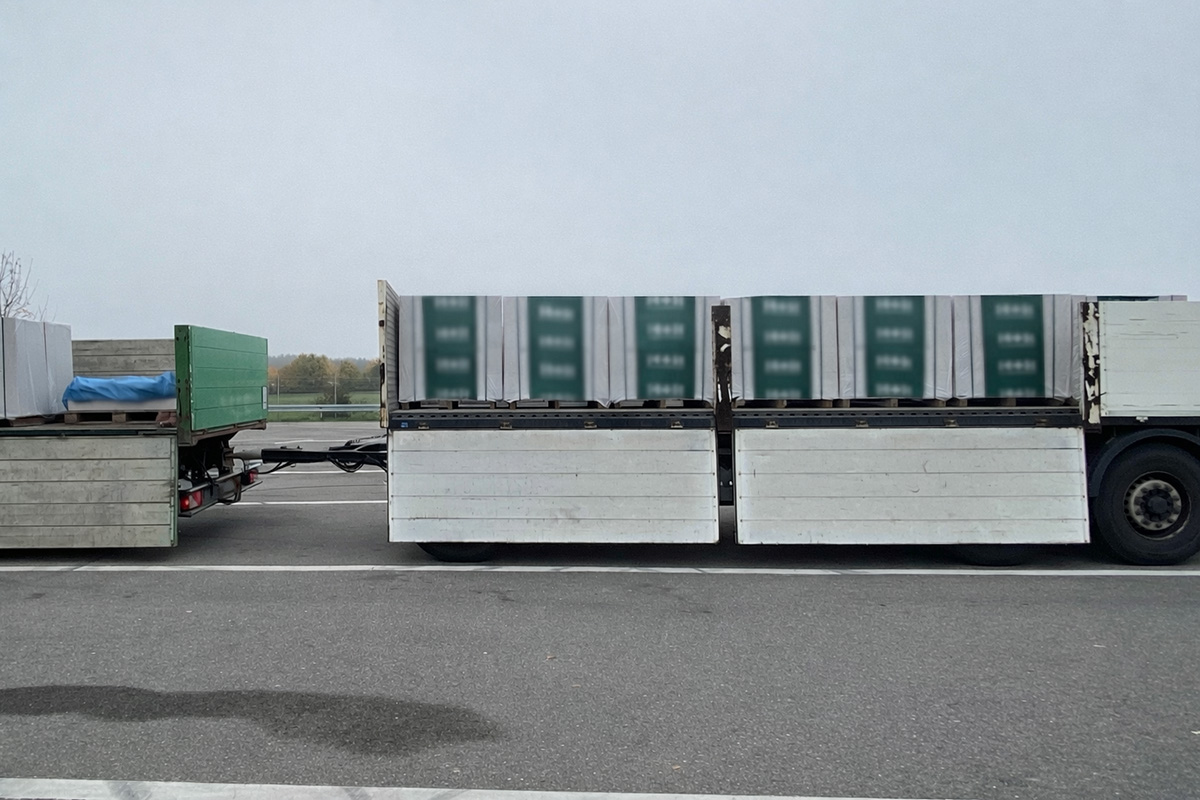
Figure 1 [Max Reich]
This was a shame because the vehicle had more than enough load securing equipment on board. Ironically, the edge protectors and other items of equipment themselves were held down by lashing belts.
Again and again, we hear people saying things like “the load is so heavy that nothing can happen”. Unfortunately, we human beings can do nothing to change the laws of physics and that is why we must secure loads appropriately.
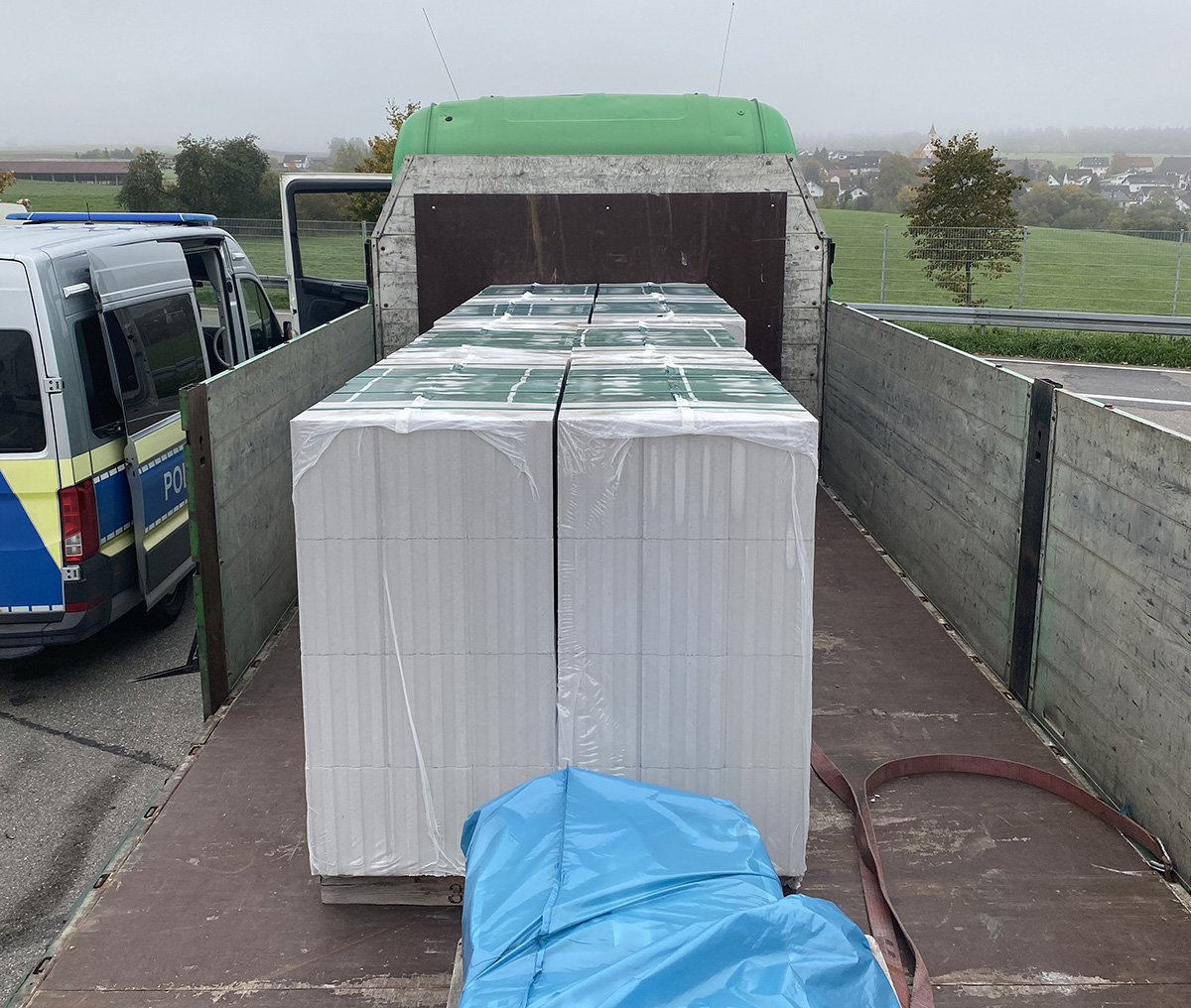
Figure 2 [Max Reich]
Let’s start with the situation as it was recorded at the site of the inspection:
We have a load of 24 tonnes. Of this, 0.8 Fg is acting in the direction of travel, or in more practical terms, we can say that 80 % of the weight of the load is pushing in the forward direction. This corresponds to a forward force of 19,200 daN.
From this, we can deduct the effect of friction. The photos show that the loading surface is relatively clean, so, from our safety-first perspective, we will assume a coefficient of friction of µ = 0.3. That means that another 30 % of the weight of the load is accounted for: 19,200 daN minus 7,200 daN due to friction leaves us with approximately 12,000 daN that is able to act on the end wall.
Admittedly: This is a simplified account of the situation. However, the issue of whether the end wall with the board bolted to it is able to withstand such a force is highly questionable.
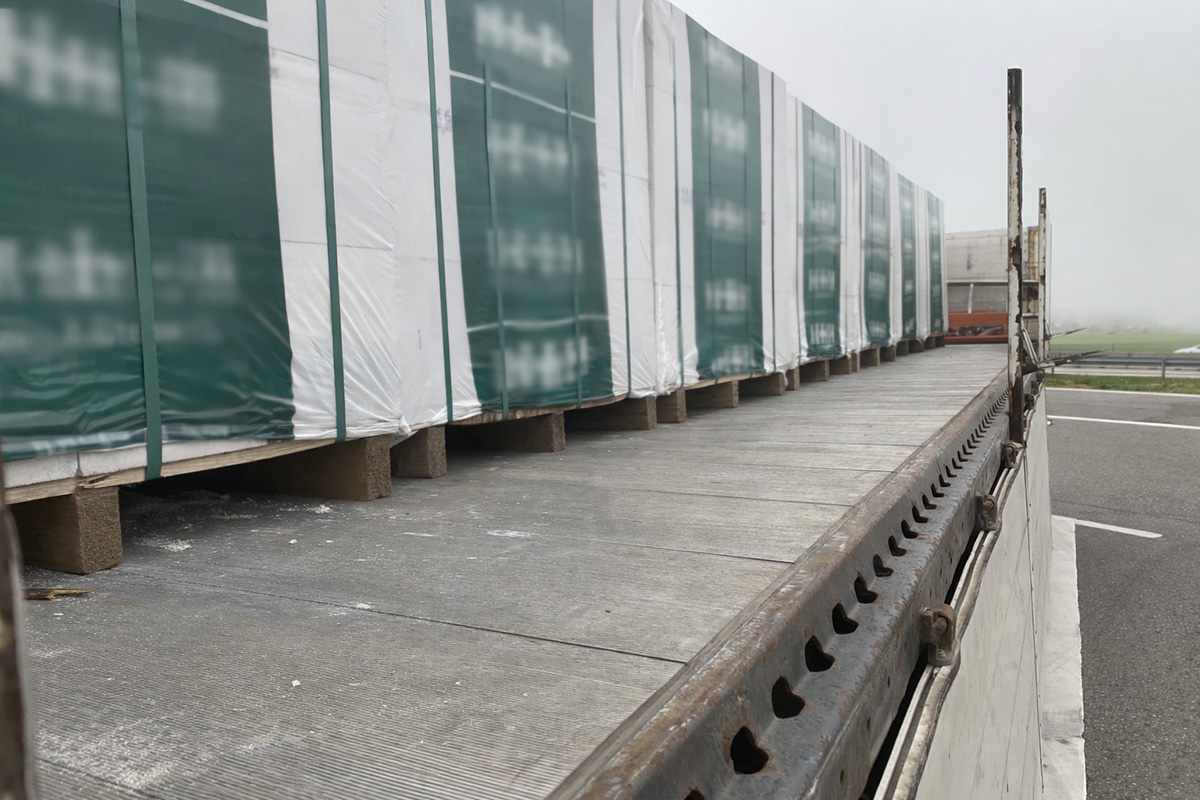
Figure 3 [Max Reich]
There is no need for any calculations about the situation at the sides and to the rear because not a scrap of load securing equipment is to be seen there.
It should be noted that it can probably be assumed that the strapping and sheeting used for the pallets form stable load units capable of withstanding the usual forces experienced during road transport.
How are inspectors supposed to verify this in a DIN 55415-compliant inspection without engaging their own responsibility?
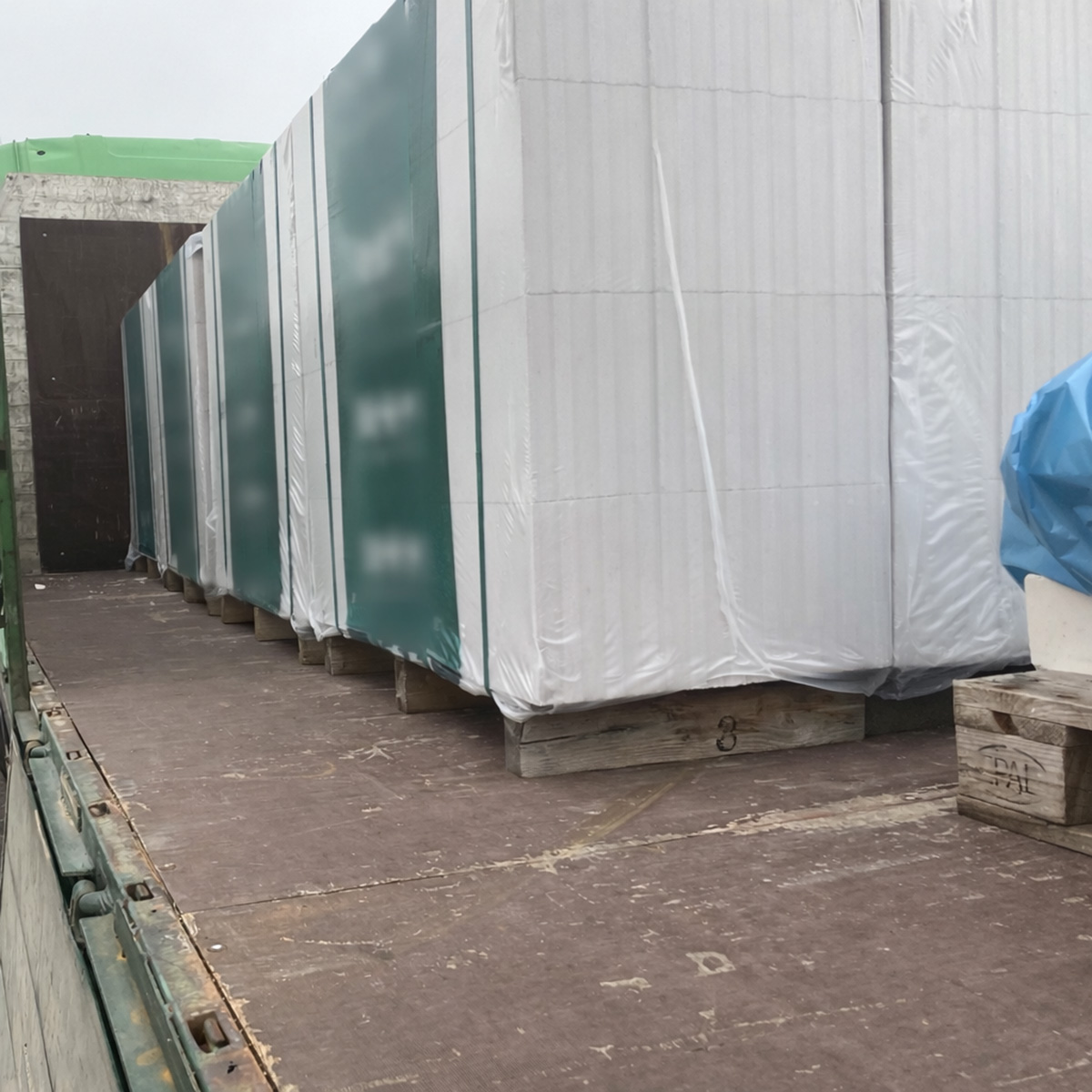
Figure 4 [Max Reich]
There is no load securing material whatsoever at the flat pallet behind the blocks.
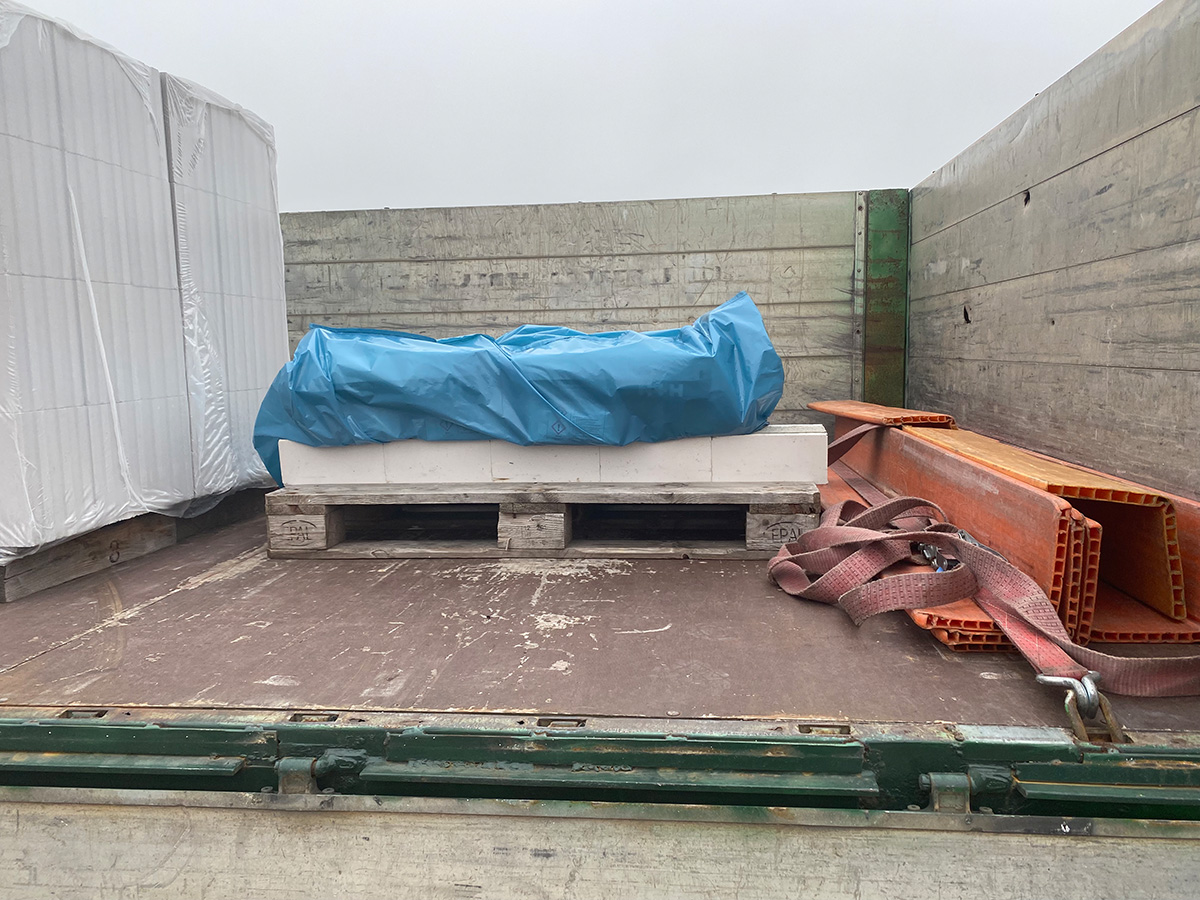
Figure 5 [Max Reich]
What could have been done differently here?
Anti-slip mats often work their magic in situations like this and can generally be assumed to have a coefficient of friction of µ = 0.6. If they had been used uninterrupted on a well-swept floor than there would only have been a force of 4,800 daN acting through the tight fit – a much more realistic value for the end wall that was used here. And if the end wall is not able to absorb such a load, then the solution is a head loop formed with a lashing belt with an LC (lashing capacity) of 2,500 daN – the load will then be adequately secured in the direction of travel.
Theoretically, anti-slip mats would be enough to cope with the forces of 0.5 Fg acting to the rear and the sides. However, the load will still move during transport, for example due to the road conditions. The solution is to pass a belt over each row and pretension it slightly – the load is now also optimally secured in these dimensions.
Meaning that if an inspection does take place then there are no difficulties, and no fines to pay – either for the truck driver or for the loaders who sent the goods on their way.
By way of comparison: What would happen if the cargo were to be loaded without anti-slip mats? Assuming a tight fit to the front, a lashing angle of 60° and a pretensioning force (STF) of 350 daN per lashing belt, then EN 12195-1 tells us that we would still need a total of 29 lashing belts.
We could save all this effort simply by using anti-slip mats. Quite apart from the fact that the vehicle floor would have to be able to absorb the extra force exerted by 29 lashing belts in addition to the weight of the load.
Your load securing columnists wish you all a safe March!
Back to beginning