



| Photo of the month – October 2026 |
[German version] |
How a load becomes a public menace
A family of three were driving to their holiday destination in France. On a freeway in Belgium, their car was driving behind a pickup truck that was transporting a number of long wooden beams.
One of these came free from the loading bed during the journey and fell onto the carriageway. The family in the car behind barely had any time to react.
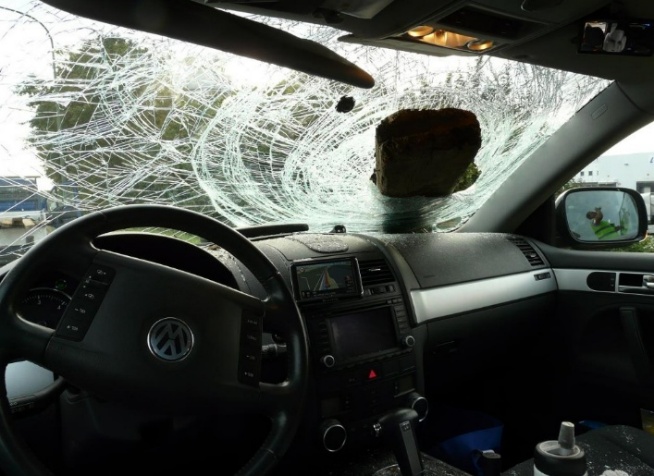
The beam struck the windshield.
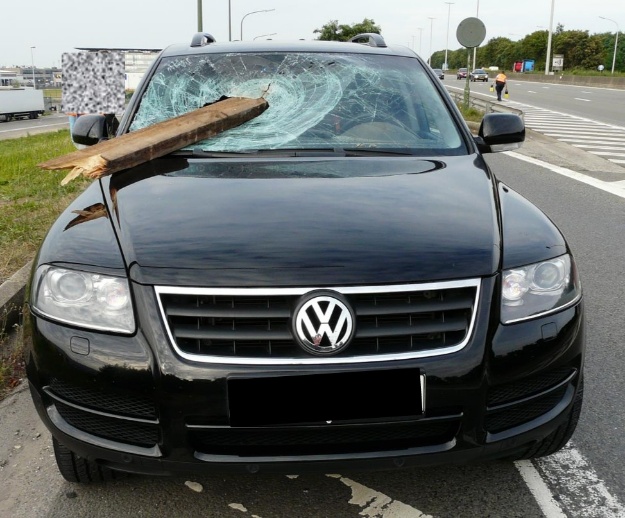
Figure 1 [Raymond Lausberg]
The beam pierced the windshield and penetrated deep into the passenger compartment. The driver and front-seat passenger were uninjured. Their son was sitting on a child seat in the middle of the vehicle’s rear seat. The beam came to a halt just in front of him. The child was also uninjured.
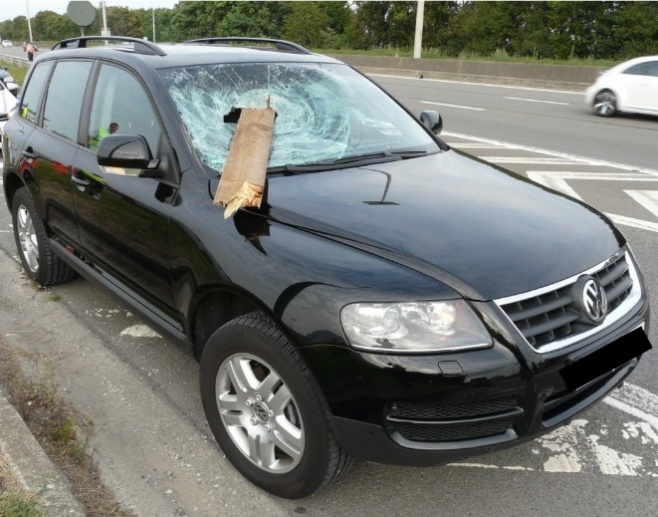
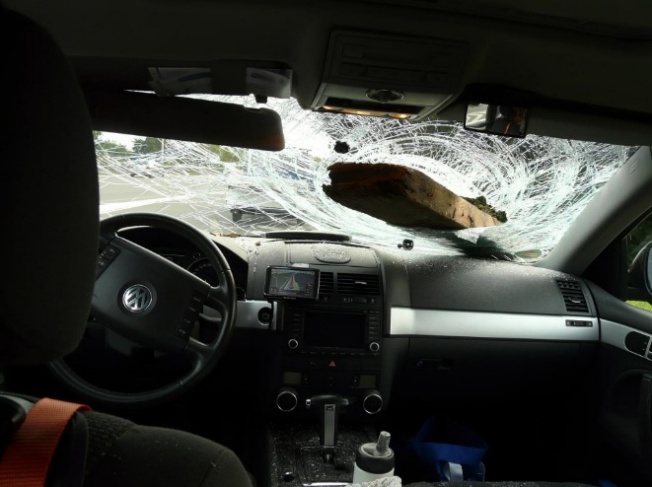
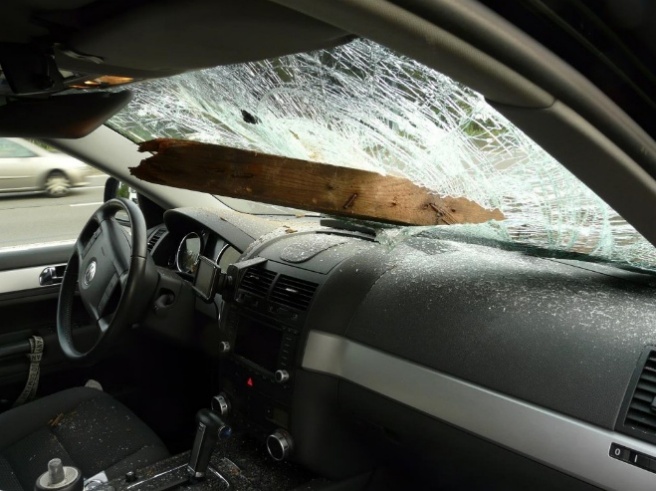
Figures 2 – 5 [Raymond Lausberg]
The view looking forwards from the child seat is particularly frightening. The photos make it all too clear just how badly this accident could have turned out for the family.
But how was a single wooden beam able to escape from the transporting vehicle in the first place?
Let’s take a look at the way the load was secured.
The wooden beams were longer than the pickup truck’s loading bed and were therefore being transported with the tailgate down. They were held in place by two lashing belts
The belts were used as tie-down lashings.
When this securing method is used, the pretensioning force of the lashing equipment should press the load down onto the loading surface. This increases the friction and therefore helps prevent the load from moving.
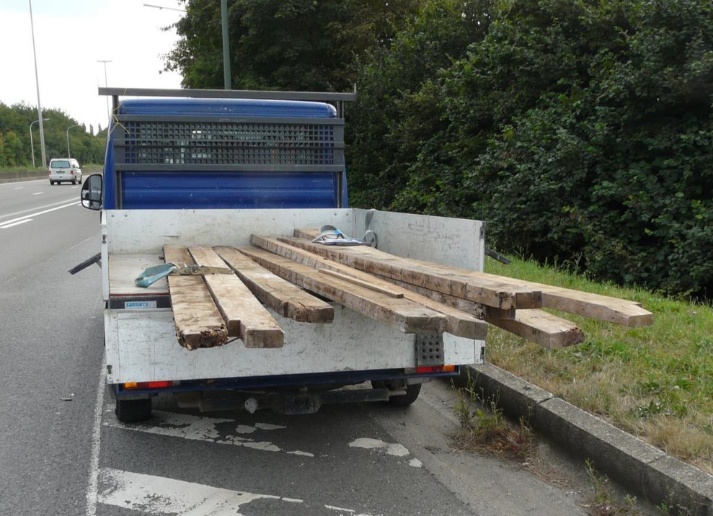
Figure 6 [Raymond Lausberg]
However, the photo shows the very shallow angle at which the two belts were attached. When the lashing angle is as small as this, only a correspondingly small proportion of the pretensioning force acts in the direction of the loading surface. This considerably reduces the additional downward pressure which is crucial when tie-down lashings are used.
- There was also no anti-slip material to increase the friction between the wooden beams and the loading surface.
What matters, however, is the result: The existing load securing arrangements could not prevent one of the beams from moving backwards during the journey and ultimately leaving the loading bed.
Loads must be secured in all directions
This case clearly illustrates a principle that can easily be lost sight of when judging the way a load is secured.
It is not enough for a load to look firmly fixed in place on a vehicle or for it to be held by multiple items of lashing equipment. Load securing must be designed in a way that enables it to absorb all the forces that arise during transport in all relevant directions.
Different forces act on the load depending on whether the vehicle is braking, accelerating or cornering. An appropriate load securing solution must therefore take account of movements forwards, backwards and to the sides.
The accident we are discussing here shows exactly why it is important not to to forget to secure the load against the direction of travel. In this case, the employed load securing was not enough to stop one of the beams moving backwards.
What could have been done to secure the load on this vehicle?
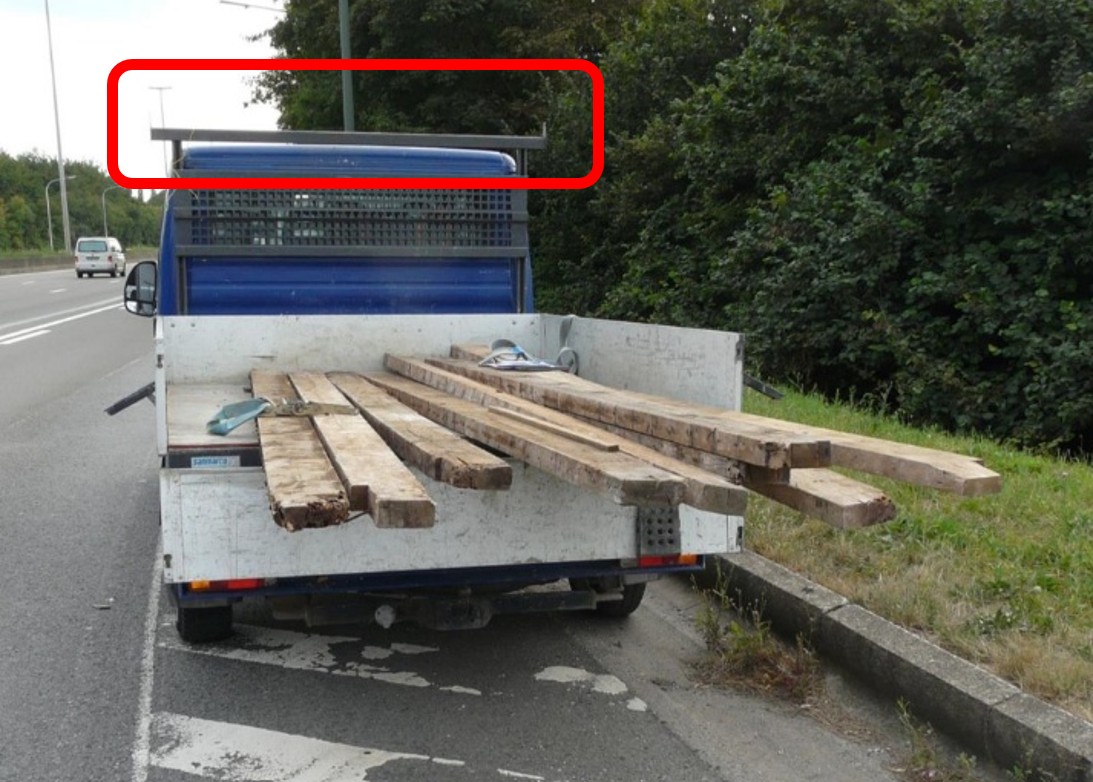
According to the information available to us, the pickup truck was equipped with a crosspiece behind the driver’s cab which could have been used to transport long items such as these beams.
Figures 7 [Raymond Lausberg]
One alternative solution would therefore have been not to transport the beams more or less horizontally with the tailgate open as was the case here. Instead they could have been loaded diagonally and stowed using the existing crosspiece. That would also have made it possible to close the tailgate.
However, just arranging a load differently does not mean that it no longer needs to be secured. Even if the crosspiece had been used, it would still have been necessary to check what securing equipment was needed to prevent the beams from moving in any direction. For example, a lashing belt could have been tensioned over the diagonally stowed beams and hooked into the first lashing points on the loading bed. With a little pretensioning force, the beams could have been pressed down, preventing them from moving forwards, backwards or to the side.
We lack important information needed to calculate the actual, real-life load securing requirements, in particular regarding the weight of the beams, the friction that could be achieved and the capacity of the available securing equipment. Reliable estimates of the requirements are therefore not possible based on the available information.
However, the present case does allow us to draw one clear conclusion: What matters is not how many lashing belts are used. The vital thing is the securing effect that is actually achieved using the chosen method.
Conclusion
Wooden beams are neither unusual nor, seemingly, particularly complicated items to transport. That is precisely why the consequences of unsuitable securing can be so easily underestimated.
In the present case, a single beam escaped the transporting vehicle, pierced the windshield of the car behind and penetrated right through into the passenger compartment.
Load securing therefore not only protects the transported goods. It also protects the driver, the vehicle and, above all, other road users who have absolutely nothing to do with the transport operation.
Suitable stowage and matching load securing arrangements must ensure that the load withstands the stresses that arise in all directions during transport.
The photos show more eloquently than any detailed description just how close the example presented here came to ending in tragedy.
Back to beginning