


| Photo of the month – September 2026 |
[German version] |
Load distribution that meets the demands of the journey – an often undervalued prerequisite for secure transport
The following examples come from a range of transport operations at a port facility. Even though some of the photos are several years old, they illustrate a problem that still regularly leads to damage to cargo and transport vehicles today.
When planning a transport operation, the focus is often placed on lashing equipment, chains or other load securing devices. However, it is equally, if not more, important to consider how the forces and stresses that arise are transmitted into the transport vehicle.
In particular, heavy goods with small contact surfaces can be extremely problematic in terms of stowage and load distribution:
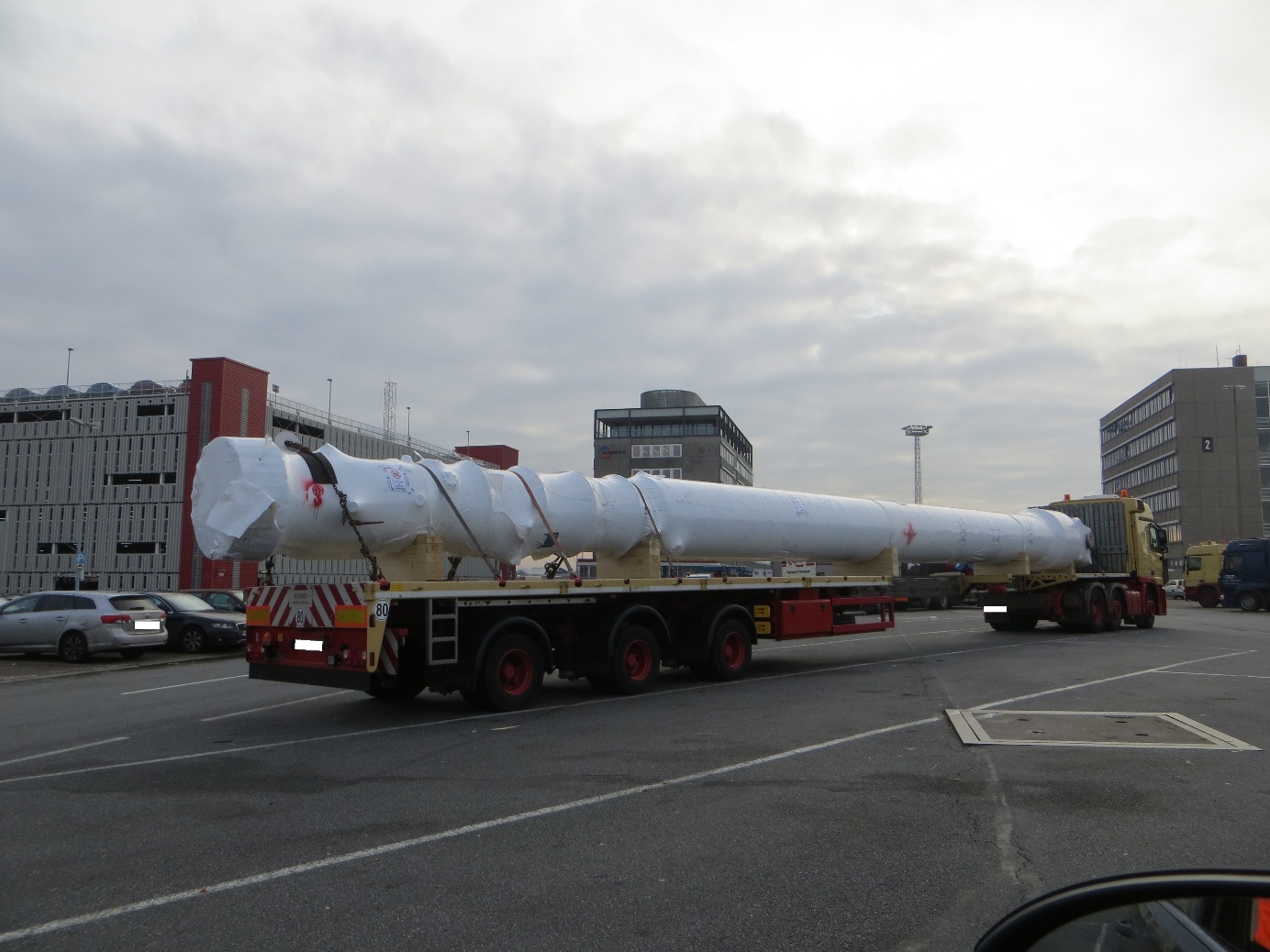
Figure 1 [Marc Sommerfeld]
When a heavy cargo such as the one depicted in Figure 1 is delivered by truck then it is the comparatively small load-bearing contact surfaces that immediately catch the eye. The entire weight of the cargo is transmitted into the vehicle through these supports.
This means that there can be high pressures per unit area even when the load is stationary. During transport, additional dynamic loads also exert an effect, for example due to braking, acceleration or steering maneuvers. These can further significantly increase the load on the individual load-bearing surfaces.
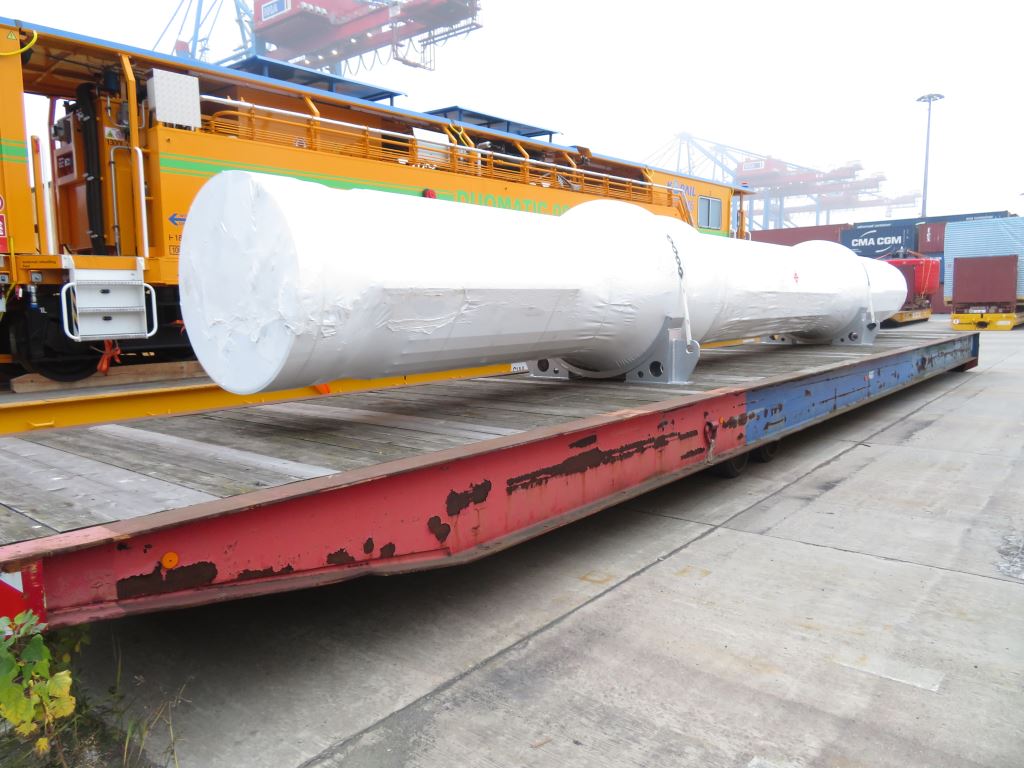
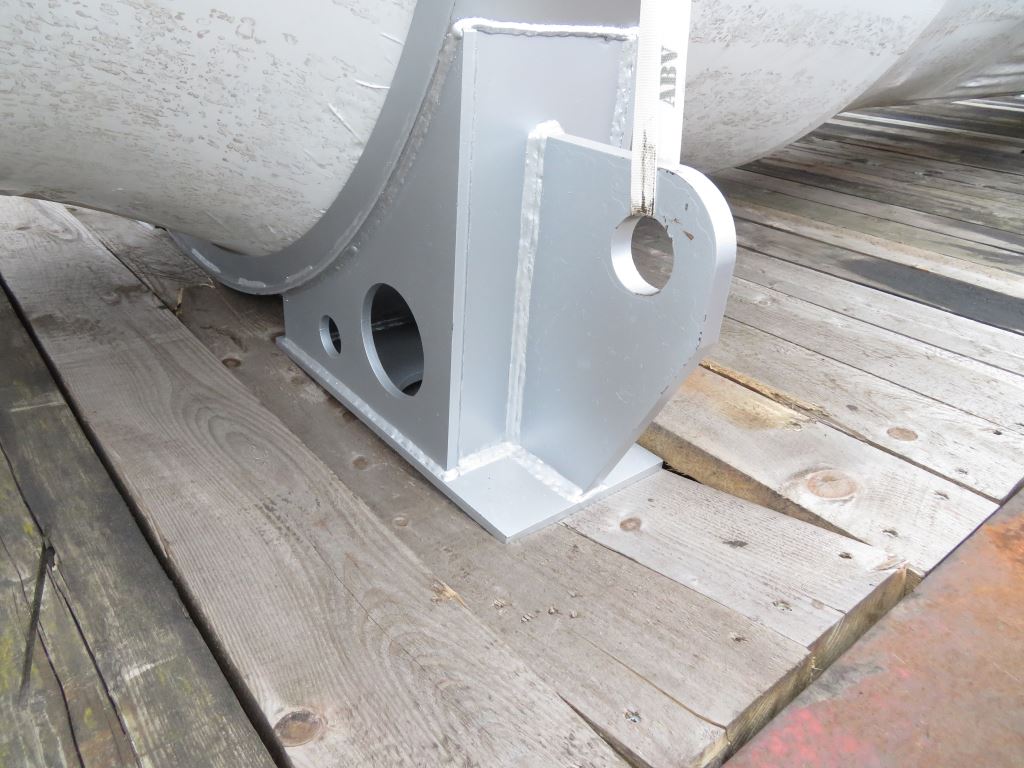
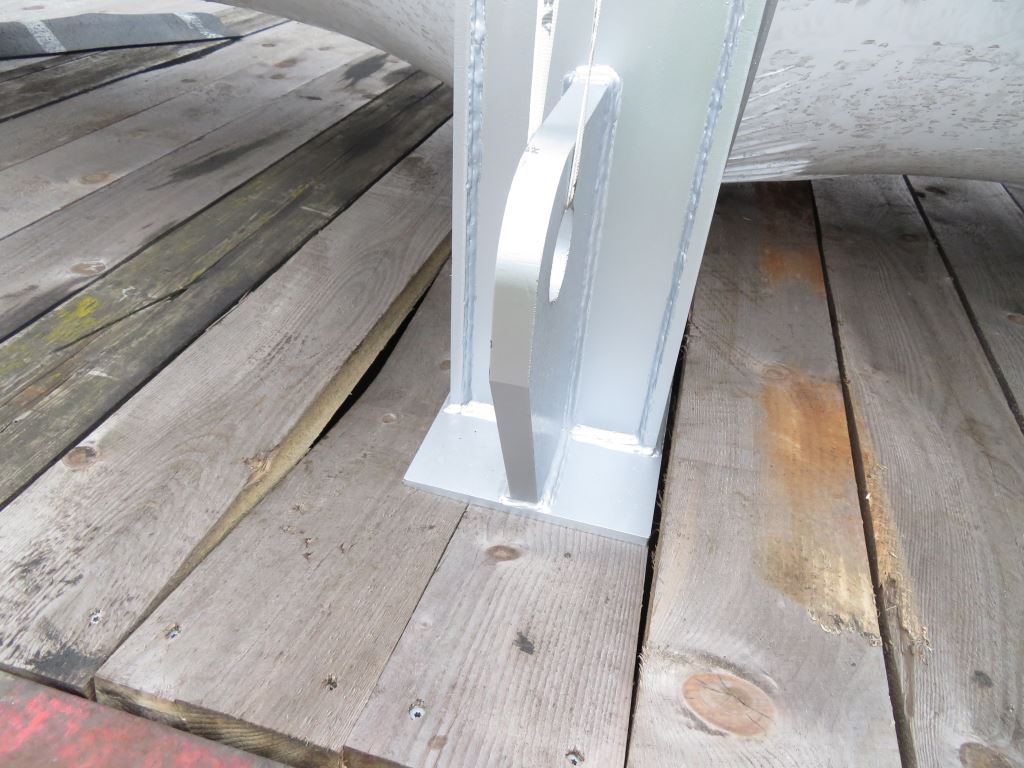
Figures 2 to 4 [Marc Sommerfeld]
The close-up photos show that the load-bearing surfaces cause considerable indentations in the loading platform simply under the intrinsic weight of the load alone.
The fact that the photo here is of a roll trailer for ro-ro transport is of only secondary importance for the underlying question. Comparable stresses also arise on the loading beds of trucks, railway carriages, swap bodies or containers. Every mode of transport has its own design-specific load limits which have to be taken into account when planning how to stow the cargo.
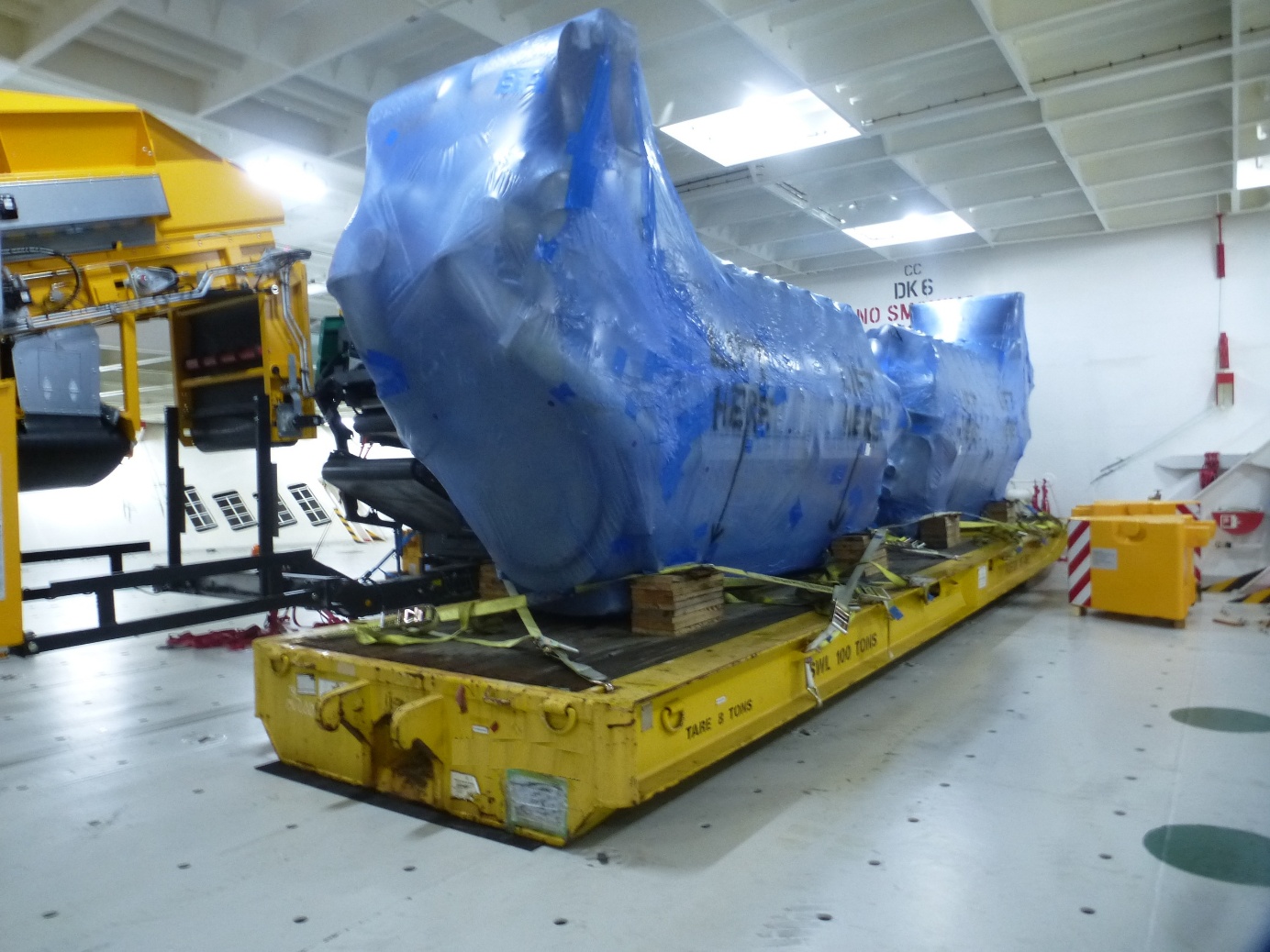
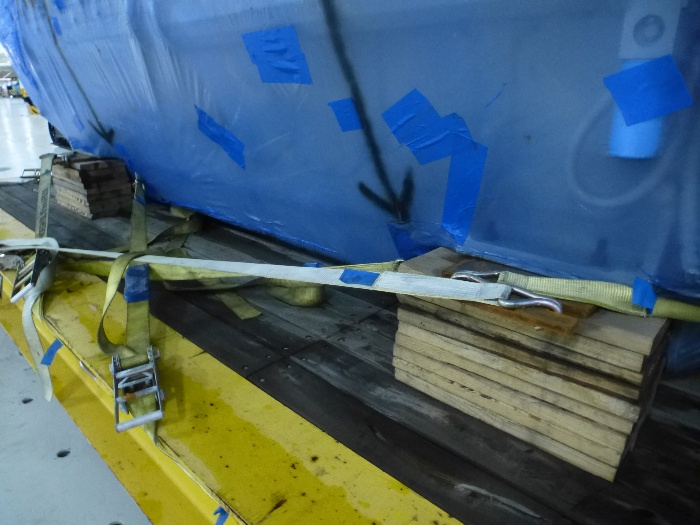
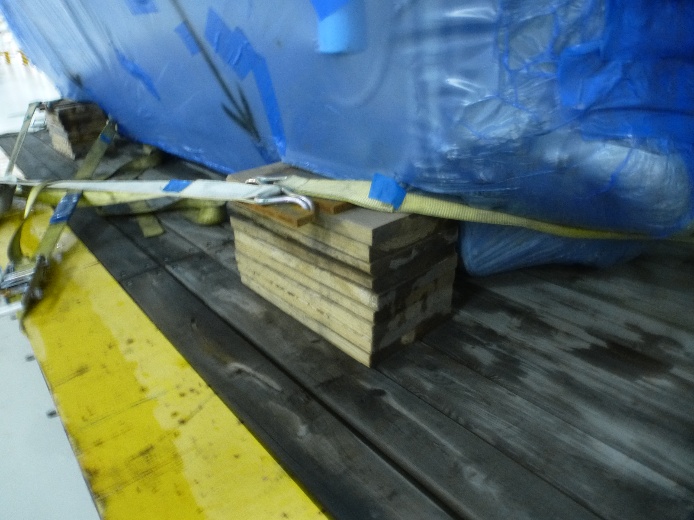
Figures 5 to 7 [Marc Sommerfeld]
At approximately 45 tonnes (per item), the load shown in Figures 5 to 7 is again extremely heavy. According to the available information, the permissible static load on the roll trailer was nevertheless still adhered to here, unlike in the previous example.
Despite this, the weight is concentrated on comparatively small load-bearing surfaces. Suitable load distribution would make it possible to guide the force into larger surfaces or directly into load-bearing components of the roll trailer. This would considerably reduce the strain both on the load-bearing surface and on the transport vehicle itself.
Dynamic loads are often underestimated
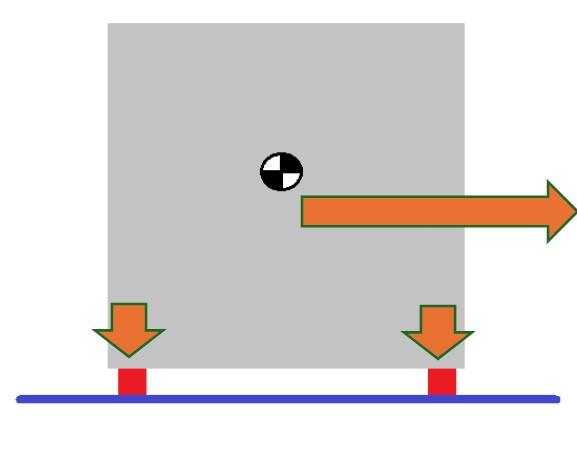 |
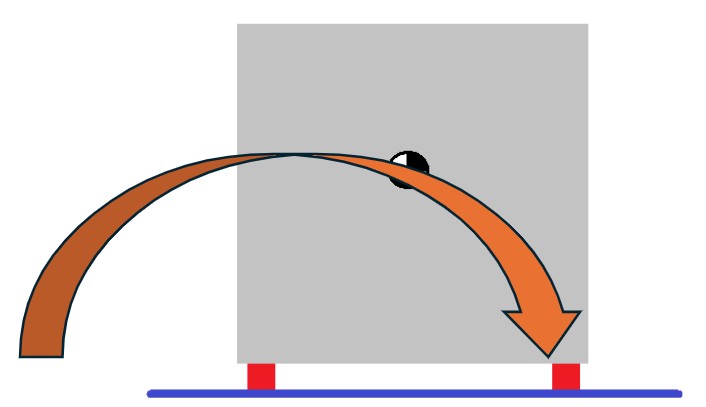
If the cargo shown here is accelerated to the right … |
 |
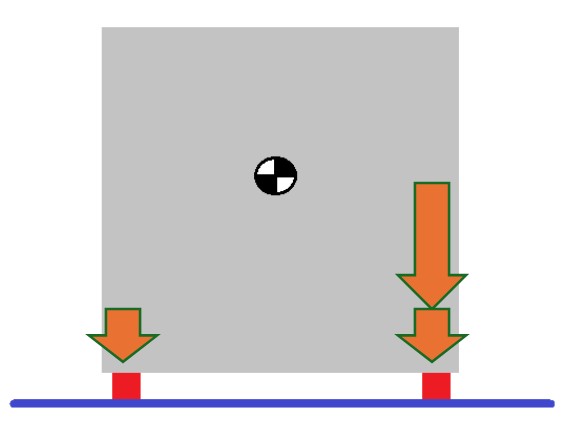
… then a torque is generated around the support which is not subject to any additional load |
 |
The calculation is very simple: If we divide the torque by the width between the base supports then we obtain an additional downwards-acting dynamic load at this point |
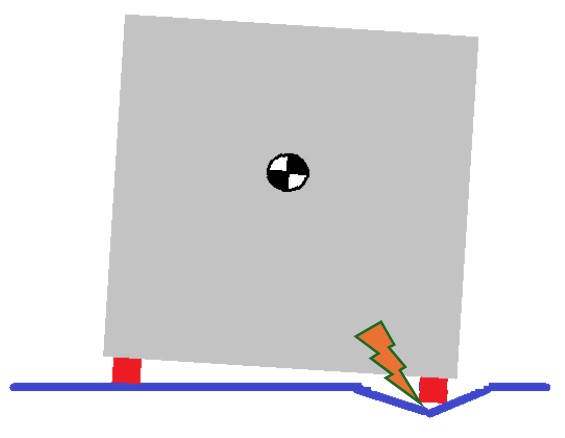 |
If the sum of the static and the additional dynamic load is too great for the loading surface then this will give way. |
Figures 8 to 11 [sketches]
During transport, the cargo is subjected to additional loads due to braking, acceleration or cornering. What is more, the effect of any given additional load will be greater at certain specific load-bearing surfaces. A base support may then press more strongly against the loading surface than in the static state. This effect may be all the greater, the higher the load’s center of gravity is and the closer the base supports are to one another. If the strain becomes too great at any given point, then the loading surface may be damaged or even fail completely. A more detailed technical explanation can be found at the end of this article.
How can load distribution be improved?
Figures 12 to 14 show an example in which the load has been successfully distributed to take account of the arising stresses.
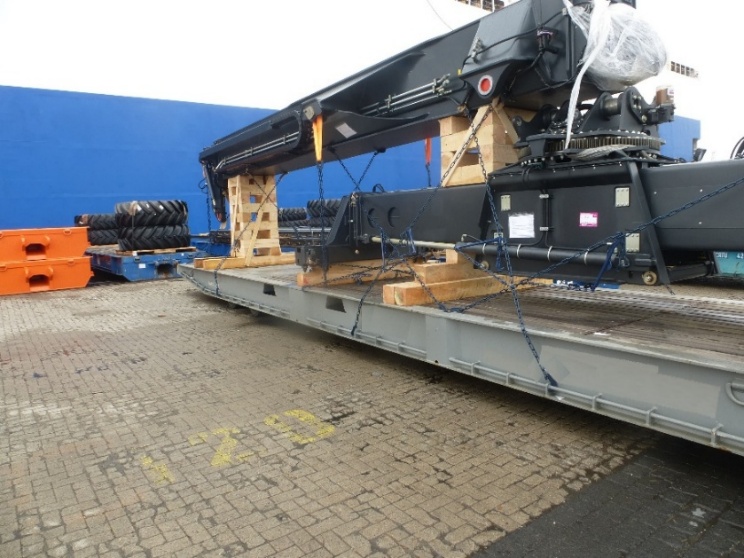
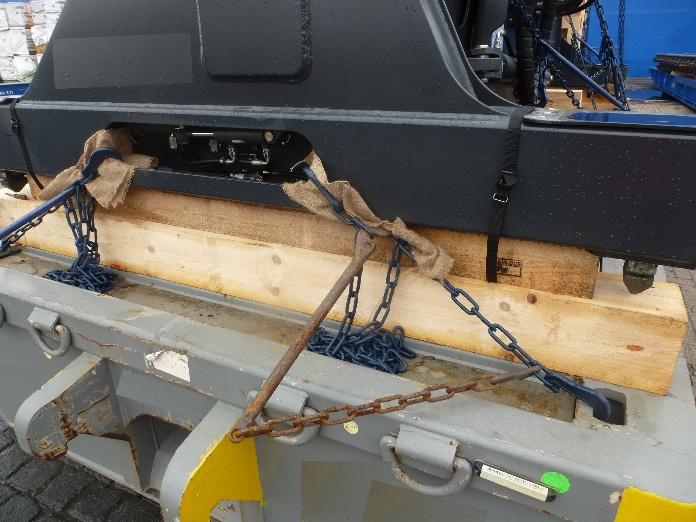
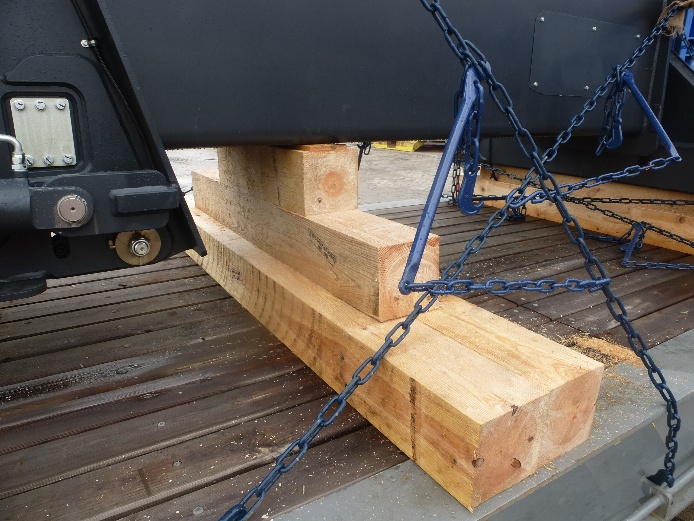
Figures 12 to 14 [Marc Sommerfeld]
Thanks to the use of a sufficiently dimensioned substructure, the loads are no longer transmitted via a number of individual points but over a considerably larger area. At the same time, the force is transferred into load-bearing areas of the transport equipment.
This type of load distribution not only prevents the loading surface from being overloaded. It also reduces the strain on the transported goods themselves and creates a solid basis for subsequent load securing.
If a substructure or loading surface is damaged or gives way due to the forces introduced into it, then the load securing measures will unavoidably also become ineffective. Therefore, for load securing to be effective, the load must always first be stowed in a way that meets the demands of the forthcoming journey.
Conclusion
The examples above make it clear that safe and secure transportation does not start and end with the load securing measures.
Instead, even when stowing the cargo, it is necessary to make sure that static and dynamic loads are introduced into the transport equipment in a way that meets the demands of the specific situation. Only then can the loading surface and substructure withstand the forces that arise throughout the transport operation.
Only when this has been done can the load securing measures do their job.
To ensure safe transport, it is first necessary to package the goods in a way that is fit for purpose or to supply the goods in suitable load units. Next, the cargo must be stowed correctly to ensure that the loads are reliably transmitted into the transport equipment. Only in this way can the load securing measures absorb the forces that arise during transport.
The three factors of packaging/load unit formation, stowage and load securing cannot therefore be considered independently of one another. Together, they form the securing concept for a transport operation. Each of these aspects must be suitably configured in the light of the stresses that arise during transport and must be harmonized with the others.
Your Load Securing Team

Explanation of terminology:
Static load designates the load imposed solely by the weight of the cargo in the stationary state.
Dynamic load refers to additional loads that arise during the journey, for example when braking, accelerating or cornering.
In simple terms, torque describes the rotational or tilting effect of a force. In the context of a loaded cargo, it can cause the stresses at one load-bearing surface to be greater than at another.
Technical explanation of dynamic loads:
During transport, the load is accelerated in both the longitudinal and transverse direction. For the sake of simplicity, we can consider the resulting forces to act at the load’s center of gravity. Figure 8 [sketch]
In the case of lateral acceleration, there is therefore a horizontal force acting at the height of the center of gravity. The fact that this force acts above the level of the load-bearing surface gives rise to a torque. Figure 9 [sketch]
For the purposes of the discussion below one of the two outside base support points is assumed to be the pivot point. This torque causes the base support opposite to be subjected to a downwards force, the size of which can be determined from the torque and the distance between the two supports. Figure 10 [sketch]
This additional stress is superimposed on the static load that already exists at this point due to the intrinsic weight of the cargo. It arises only when accelerations occur during the transport operation. We therefore speak of a dynamic floor load. In this simplified presentation, the static floor load remains present at the base support which is assumed to be the pivot point. Figure 11 [sketch]
If the sum of the static and dynamic floor loads exceeds the permitted load for the loading surface, then this may give way or, in the worst case, fail completely.
In particular when planning how to stow heavy goods with small contact surfaces, it is therefore particularly important to take account not only of the cargo’s intrinsic weight but also of the dynamic floor loads expected during transport.
Note:
The figures in this month’s column also raise further aspects of load securing, for example the routing of the lashing belts or the selection of the chains that are to be used. However, they are not considered in greater detail here, because the focus this month is placed on stowage and load distribution.
Back to beginning