



| Tank containers | [German version] |
 |
Description |
|
Figures |
|
Dimensions/weights |
|
Use |

Description
Tank containers must be at least 80% full, to prevent dangerous surging of the liquids in transit. On the other hand, they must not as a rule be over 95% full, or there will not be sufficient ullage space for thermal expansion. The extent of thermal expansion may be calculated for each cargo on the basis of the following formula:
ΔV = Va · γ · ΔT
Ve = Va (1 + γ · ΔT)
| ΔV | : | change in volume |
| Va | : | volume at initial temperature a |
| Ve | : | final volume at temperature e |
| γ | : | coefficient of cubic (thermal) expansion |
| ΔT | : | temperature difference in degrees kelvin |
Tank containers intended for transporting foodstuffs must be labeled „Potable Liquids only“.
Some hazardous materials must be transported in tank containers with no in- or outlet openings below the surface of the liquid.
Tank containers are generally designed for an operating pressure of up to 3 bar (above atmospheric). The test pressure used is 4.5 bar (above atmospheric).
If the cargo requires temperature-controlled transport, tank containers can be equipped with insulation or heating. The temperature of the cargo may be precisely controlled using temperature sensors.
Back to beginning
Figure
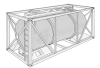 Figure 1 |
Back to beginning
Dimensions/weights
The following are some of the most important details relating to tank containers.
| 20′ tank container | |||||
|---|---|---|---|---|---|
| External dimensions | Weights | ||||
| Length External dimension to ISO [mm] |
Width External dimension to ISO [mm] |
Height External dimension to ISO [mm] |
Max. gross wt. [kg] |
Tare weight [kg] |
Max. payload [kg] |
| 6058 | 2438 | 2438 | 30480 | 4190 | 26290 |
| 6058 | 2438 | 2591 | 30480 | 4190 | 26290 |
Back to beginning
Use
Tank containers are used for liquid cargoes, such as:
|
Foodstuffs: fruit juices, spirits, sweet oils |
|
Chemicals: hazardous materials, such as fuels, toxic substances, corrosion protection agents |
Back to beginning